Jurisdiction Planning
Your family already has a map: every jurisdiction you currently touch, accumulated over a lifetime of decisions. And usually this happens by accident.
Where you bank, where your companies are based, where your children study, where you keep a home for the season: the geographic reach your family has built, one decision at a time, over a lifetime. This is your Jurisdiction Map.
Jurisdiction Planning is the work of turning that accidental map into a designed one. It sits alongside wealth planning and tax planning in family governance, and asks the question your other advisors do not: what jurisdictions are open to us that can drastically improve our family, money and purpose? Without it, your family is hostage to a map drawn by chance. With it, the family becomes a sovereign one. Protected, distributed, free to choose.
Family. Money. Purpose.
These are the three concerns of your life. Each area needs one type of Jurisdiction minimally.
Jurisdiction Control Centre
What’s the ideal Jurisdiction Map?How we know what to improve.
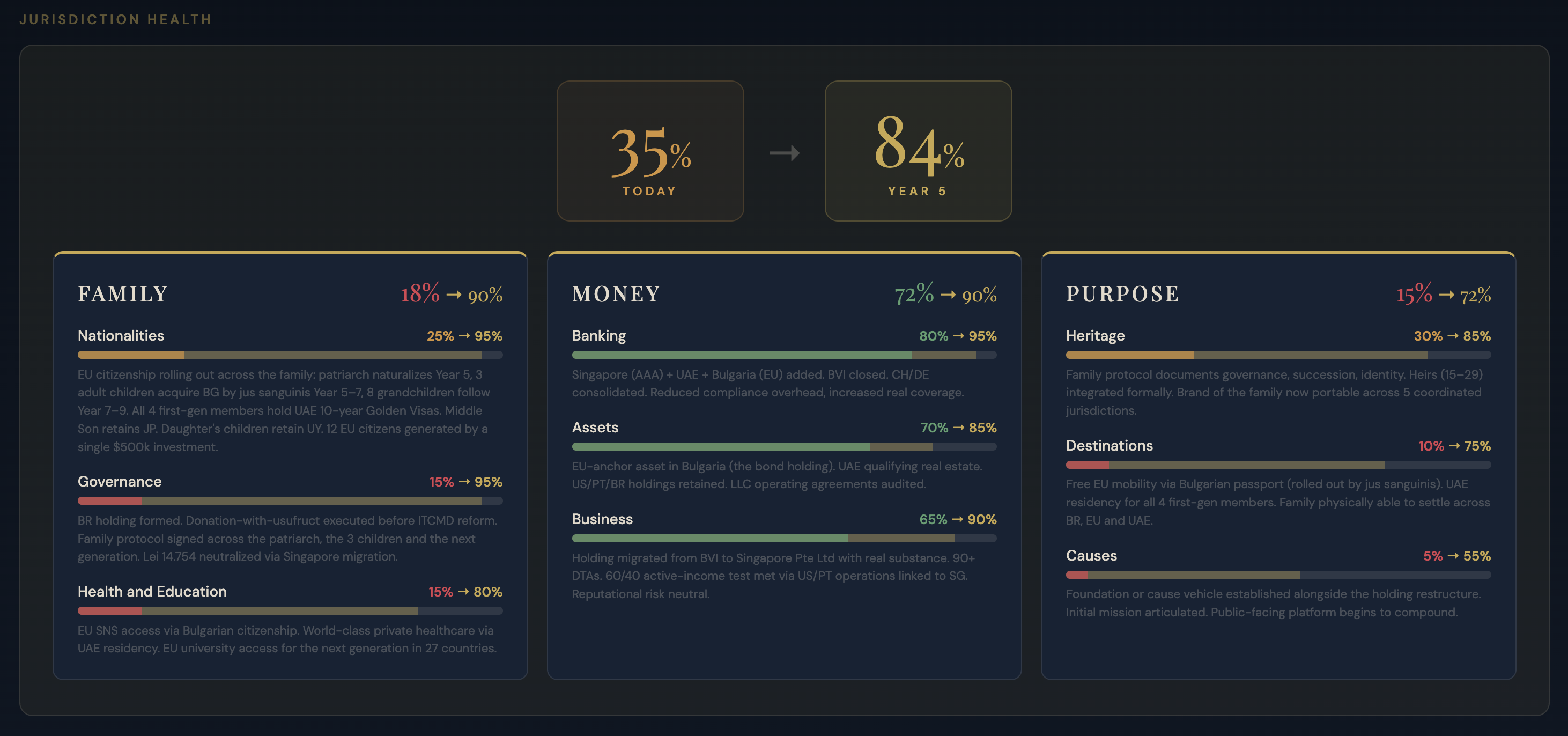
The ideal map will depend on each family's objectives, but we can easily tell whether a map is healthy or not. This is how we know what to improve. First, we read your current map. Then we identify what each new position would change for your safety, your finances, and your way of life. We give you the full picture of what each move costs and what it returns in your Jurisdiction Control Centre, which you can see below. This is a snippet of how one family improved their Jurisdiction Health:
Global Hedging.Looking at the world with Jurisdiction eyes.
As we outlined above, your Jurisdiction Map must take into consideration your family's global hedging: a minimum position in each of the three need categories, ideally held across both hemispheres, so a family's presence can reach all of the world's opportunities and diversify against the world's risks. This is one example based on common choices:
Your Starting Position.Examples by home country.
The goal is universal. The starting point is not. Three typical client origins, three different first maps. Each produces a complete hedge from where the family stands today.
Primary Programmes.Our three best programmes. Because they address many needs at once and are accessible.
The primary programmes are the highest-leverage moves a family can make. Each single engagement covers more than one of the three need categories, which is why a family that begins with one of these has already done a substantial part of the work in a single step.
Secondary Programmes.Programmes you add after the first one, to fill in what's missing.
Once the family's most pressing need has been secured, secondary programmes fill whichever positions the first engagement did not already cover.
Alternative Programmes.For families whose specific situation is better served by jurisdictions outside the primary set. Evaluated case by case.
Families with specific circumstances may be better served by jurisdictions outside the primary set. Each case is evaluated on its own.
Beyond just programmes.Why Jurisdiction Planning has become necessary.
We go further than investment migration firms. That is why we call this work Jurisdiction Planning, not investment migration: we are to investment migration firms what family offices are to banks. We serve the client, not the programme.
We manage our families' lives intimately and with total trust. We do not stop when the passport arrives. We continue monitoring, year after year, making sure each family's Jurisdiction Planning stays healthy.
The architecture above is what we deliver. The work behind delivering it sits below: continuous monitoring of how the world moves, deep diagnosis of each family's specific situation, and the curated execution of the programmes that build each position.
Movement has become a common thing. Families that fail to position themselves are no longer cautious. They are behind. Over fifty countries now actively compete for high-net-worth residents through investment migration programmes. Programmes that offered overnight approval eighteen months ago now take three months. Some have been closed entirely. The result: record millionaire exits from Brazil, the United Kingdom, France, China, and India, and record inflows to the UAE, Singapore, Portugal, and Malta.
Deep diagnosis of the three areas.Family. Money. Purpose. The specifics we actually examine.
The three areas we just outlined are the overview. The diagnosis is the deep version of each.
Where your offshore companies are incorporated, and what each one is for. Which banks hold each account, and under which reporting regime. Where you spend your holidays, and which jurisdictions you re-enter often enough to risk tax residency. Which cities are meaningful to your family — alma maters, hometowns, places of pilgrimage, family compounds. What diseases family members may have, and which jurisdictions treat each best. Which schools your children should attend, and where those schools' graduates settle.
Each area carries a structural need that families cannot afford to skip. The need exists because a specific civilisational pressure is bearing on the family, and only the right jurisdictional position absorbs that pressure before it reaches them.
Each area opens into three sub-categories. Each sub-category names the specific interests that need a jurisdictional answer. The diagnosis reads your family at this depth across every jurisdiction you currently touch.
In a single short meeting we can read the full position of your family across all three areas and identify the moves that will most efficiently complete the picture. A different citizenship, residency, or filing changes tax planning, succession, hospital access, schools, banking, and assets — all of it together.
Monitoring the globe.The Geopolitical Order, the Jurisdiction Risk Index, and how we read the world.
We do not read your family in isolation. We read it against the world it lives in.
Between us, the four founders hold decades of senior experience across cross-border banking, sovereign-wealth advisory, geopolitics, and international tax — earned in Europe, the Gulf, Asia, and Latin America. Monitoring the globe is the founders' daily work, read for our own use rather than commissioned from an outside feed or research firm.
The world is entering a period of multipolar competition not seen since before 1945. We watch how it moves so the diagnosis stays current.
Three major economic blocs are competing for influence, capital, and talent across approximately thirty distinct economic zones and seven critical geographic chokepoints that determine trade, capital flow, and strategic leverage. We monitor how this competition shifts the conditions that jurisdictions offer to families. When a superpower gains influence over a zone, tax regimes tighten or loosen, banking regulations shift, residency conditions change, and enforcement postures harden or relax. Our reading is published openly in the Journal for Jurisdiction Planning, the reference publication our practice edits: the thirty zones in Influence Zones and the narrows in The Seven Chokepoints.
The three areas above are the positives a family pursues — what to build, where to live, where to bank, where to school. The Jurisdiction Risk Index reads the negative side of the same coin: what makes a country impossible to live in, regardless of what the family is trying to build there. Where you should live, and where you should not: both are what we map.
Our proprietary Jurisdiction Risk Index cross-references data from the world's leading economic, political, and security sources to produce a single composite score that measures the risk a family faces by holding their primary jurisdictional base in a given country. Four vectors of risk:
Sources behind the Index
Your Jurisdiction Control Centre.A continuously updated picture of every jurisdiction your family touches, scored and projected.
The Control Centre answers three questions, plainly. The first is where your family stands today across every jurisdiction it touches. The second is where it can stand in five, ten, or twenty years if you act, with what each move costs and what each move delivers. The third is what happens if you do nothing: which exposures compound, which windows close, which protections you lose.
The Jurisdiction Control Centre is a continuously updated picture of every jurisdiction in which your family has presence, exposure, or dependency. It shows your current position scored across Family, Money, and Purpose, and a projected position once the recommended moves are made. The Control Centre also shows an estimated horizon — how many years your family is set before any change is needed.
It tracks the jurisdictions you are currently exposed to and the ones you are considering, so you can see both opportunity and exposure forming before they arrive. Legislative changes, tax regime shifts, banking regulation updates, residency programme modifications, new financial hubs entering favourable cycles: tracked, interpreted, and surfaced as they happen.
Where one jurisdiction closes a window, another opens one. The same vigilance that flags exposure also surfaces emerging markets, new treaty regimes, and residency windows that compound for the families positioned early. The Control Centre is as much a record of where to move toward as it is of what to move away from.
Senior jurisdiction advisors maintain it and read it for you. When a new law, a geopolitical shift, or a policy window opens or closes, you do not interpret it alone.